| |
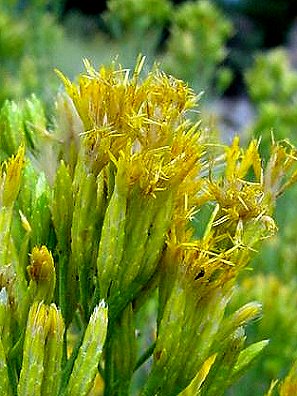
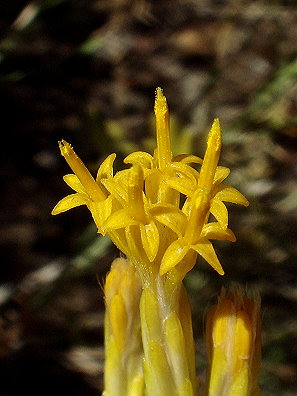
Pictures of Mojave rubber rabbitbrush are not
going to show any differences between this subspecies and threadleaf
rubber rabbitbrush (ssp.
consimilis), because the main differences are in subtle characteristics
like the length of the involucre. I have searched diligently for
definitive discriminants, but most things that differentiate these two
sspp. are so variable and with such an overlap in most dimensional ranges
as to be almost useless. Ssp. mohavensis is supposed to
be often leafless, but I have observed it to be often leafy. The
leaves are supposed to be 1-3 cm but I have observed it often to have
leaves with a maximum length of 5-6 cm (these on specimens with an involucral
length of 11 mm, well beyond that for ssp. consimilis). The
phyllaries are supposed to be sharply angled, but I have seen ssp.
consimilis with equally angled phyllaries. The phyllaries
are also supposed to be strongly keeled, but this is an extremely obscure
characteristic which does not always seem to be visible even under a
microscope. My inclination based on having studied individuals
of both of these sspp. all across the San Gabriels is to think that
they should never have been made into separate taxa, but they may separate
well in other areas. Here mohavensis and consimilis
appear to form an intergrading complex, but all of the floras list
them as unique taxa, so I am keeping them as separate in this website.
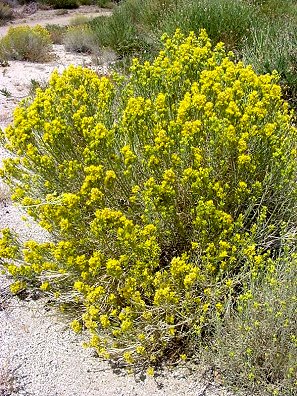
Anyway, this is a few-branched perennial shrub growing some 3-8'
tall with threadlike leaves (or none). The involucres basically
range from 9-12 mm in length and are glabrous. Mojave rubber rabbitbrush
is common through dry scrubby environments in the Transverse Range and
Mojave Desert, often occupying joshua tree woodland and creosote bush
scrub, primarily from about 2500' to 6000', and blooming from September
to October. They are particularly prevalent along road edges.
These pictures were taken along Mt. Gleason Road in the San Gabriel
Mts.
Click here for Latin name derivations: 1) Chrysothamnus
2) nauseosus
3) mohavensis.
Pronunciation: kry-so-THAM-nus naw-zee-OH-sus
mo-ha-VEN-sis.
Click here for Botanical
Term Meanings.
|
|