| |
Long-beaked storksbill or filaree is a prostrate
to erect introduced annual that has retrorsely hispid stems. There
is a basal rosette of leaves and sometimes that is all you see of the
plant. The cauline leaves are opposite, ovate to oblong-ovate,
shallowly to deeply pinnatifid, and bristly-hairy on the veins and margins.
The stipules are ovate, somewhat scarious, and often a deep reddish-green.
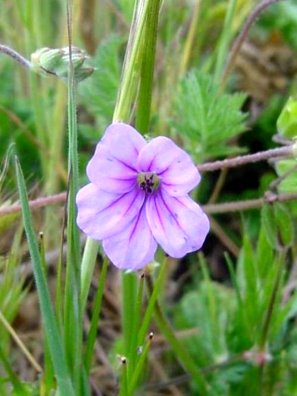
The flowers are solitary or in several-flowered umbels on peduncles
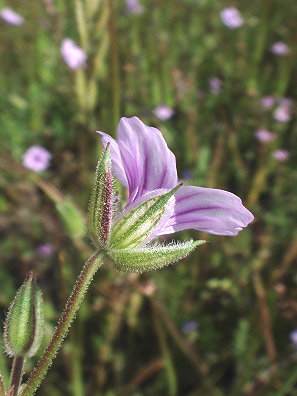
to 4" long. There are five bristly-tipped and reddish sepals
and five lavender to red-violet petals marked with purple veins. The
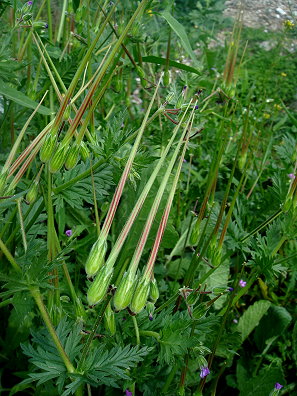
style column is elongated to as much as 5". The fruit body
is about 7/16" long, and is fusiform and indehiscent. Upon
maturity, the style splits into five one-seeded sections. This Erodium
is found in grassy areas and along roadsides at elevations to 3000'
throughout California except for the desert, but is not as common as
its relative, E. cicutarium. It is a native of the Mediterranean
region, and blooms from March to May.
Click here for Latin name derivations: 1) Erodium
2) botrys.
Pronunciation: er-OH-dee-um BOT-ris.
Click here for Botanical
Term Meanings.
|
|