| |
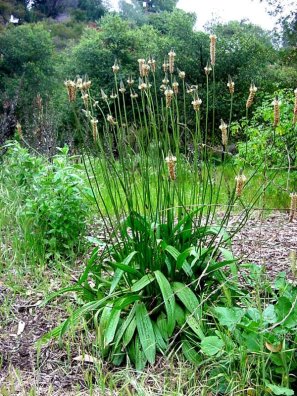
English plantain is an introduced somewhat short-villous
perennial growing to 32" from a stout, taprooted caudex with basal
leaves that are lanceolate to lance-oblong, erect to spreading, parallel-veined,
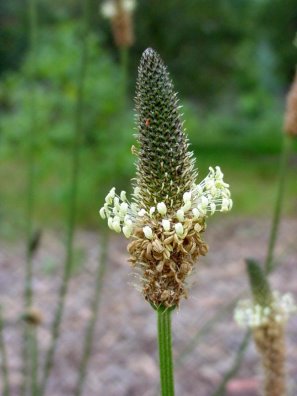
up to 8" long, and attenuate at the apex. The numerous flowers
are clustered at the ends of slender, arched-ascending scapes on dense
spikes that are ovoid-conic becoming cylindric and 3/4" to 3"
long. There are 4 fused sepals, 4 fused petals, 4 well-exserted
stamens and 2 fused carpels united into a single pistil. The fruit is
an oblong-ovoid capsule, dehiscing below the middle, and containing
1-2 shining brown seeds. English plantain, not surprisingly, was introduced
from Europe, and is a common weed in lawns and disturbed and moist places
to an elevation of 4000' or 5000', blooming from April to August.
Click here for Latin name derivations: 1) Plantago
2) lanceolata.
Pronunciation: plan-TAY-go lan-see-o-LAY-ta.
Click here for Botanical
Term Meanings.
|
|