| |
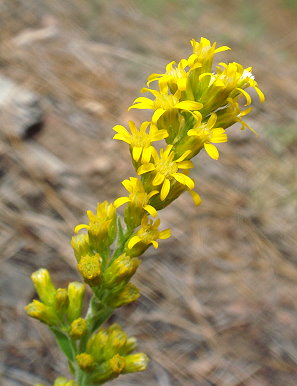
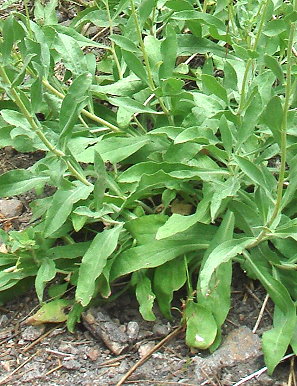
California goldenrod is a robust, erect herbaceous
perennial from 8" to 4' tall. The stems and leaves are ashy-gray
colored and densely downy. The leaves are alternate, the lower oblanceolate
to ovate, serrate, obtuse- to acute-tipped, and tapering to the base,
and the upper much reduced, elliptic, entire and sessile. The
inflorescence is long, mostly 1-sided, and somewhat pyramid-shaped.
The many flowering heads are radiate and contain 8-13 ray flowers and
4-12 disk flowers, all yellow. The phyllaries are narrow-oblong to lance-linear,
sharply acute to obtuse, and strigose. The achenes are densely hispidulous
and each has a pappus of many white, hairlike bristles. This attractive
species is found below 8000' in both dry and moist environments, in
the open and in shaded woods, from coastal sage scrub to yellow pine
forest, and in cleared or disturbed places. California goldenrod blooms
from July to October. The first three pictures were taken on the Upper
Mt. Wilson Trail in the San Gabriels, and the third was taken in Blue
Sky Ecological Reserve near San Diego.
Click here for Latin name derivations: 1) Solidago 2) velutina 3) californica.
Pronunciation: sol-i-DAY-go vel-OO-tin-a ka-li-FOR-ni-ka.
Formerly Solidago californica.
Click here for Botanical
Term Meanings.
|
|